


The Reader in the Furnace
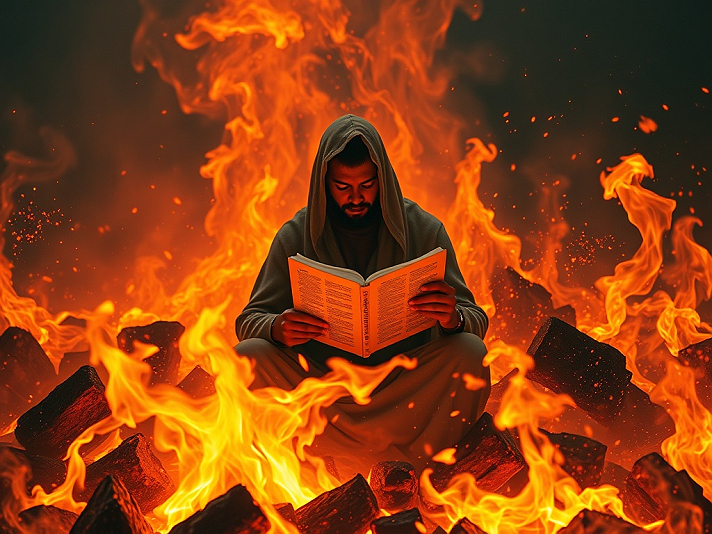
The image depicts a solitary figure seated cross-legged in the center of a roaring inferno, yet he remains untouched by the flames that rage around him. He wears a simple hooded robe the color of ash, and his head is bowed in quiet absorption over an open book resting on his lap. The fire is not a mere backdrop; it is the entire world. Towering walls of orange and crimson curl upward like living serpents, licking at the edges of the book’s pages without singeing them, leaping over the man’s shoulders without scorching his skin. Sparks drift lazily through the air like fireflies, and charred logs glow beneath him, yet he sits in perfect stillness, as though the blaze is nothing more than a warm hearth on a winter night.
This is not a scene of destruction but of absolute transcendence. The man’s calm is unnatural, almost defiant. His beard and the shadow beneath his hood frame a face that betrays no fear, no pain, no haste—only deep concentration. The book he reads is thick, its pages filled with dense text, and the firelight dances across the words as if illuminating them rather than consuming them. Whatever he is reading has rendered the inferno irrelevant. The flames, which should represent chaos, terror, and annihilation, have become mere atmosphere, a dramatic curtain drawn around a moment of private revelation.
At its core, the image is a visual parable about the supremacy of the inner world over the outer. Fire has symbolized purification, judgment, passion, and apocalypse across centuries of human storytelling, yet here it is stripped of all power. The man does not fight the fire, does not flee it, does not even acknowledge it. He has entered a state of consciousness so complete that external catastrophe cannot breach it. This is the stillness of the mystic who has found truth, the scholar who has uncovered forbidden knowledge, the monk who has achieved nirvana amid the burning house of samsara. The flames are the world’s distractions—anger, desire, fear, ambition—and the book is the single point of focus that renders them meaningless.
There is also a subtle undercurrent of rebellion. By sitting calmly in the heart of destruction, the figure challenges every instinct that screams for self-preservation. He is not a victim of the fire; he has chosen to remain within it. This choice suggests a radical acceptance, even a kind of ownership, of suffering and chaos. The fire is not his enemy—it is his context, his crucible, perhaps even his teacher. The book, then, may contain the wisdom that allows him to transform agony into insight. He reads not to escape reality but to master it.
Visually, the composition reinforces this interpretation through deliberate contrasts. The man’s muted earth tones—gray hood, brown robe—stand in stark opposition to the violent brilliance of the flames. He is the eye of the storm, the quiet center around which chaos spins. The fire moves in wild arcs and spirals, yet his posture is geometrically perfect: knees symmetrical, spine straight, hands steady. Even the book itself seems impervious, its white pages glowing rather than blackening. This interplay of motion and stillness, destruction and preservation, terror and serenity creates a tension that pulls the viewer into the same contemplative state the figure inhabits.
On a deeper level, the image speaks to the human capacity to find meaning amid collapse. Civilizations burn. Relationships disintegrate. Bodies fail. Ideologies crumble into ash. Yet here is a man who, surrounded by total annihilation, continues to read. The act of reading itself becomes an act of defiance, a declaration that knowledge, contemplation, and inner sovereignty outlast even the most ferocious external forces. The fire will eventually consume the logs, the sparks will die, the smoke will rise and vanish—but the words he absorbs will remain etched in his mind long after the last ember cools.
Ultimately, the photograph is less about fire or books than about the indestructibility of focused consciousness. It is a modern icon of enlightenment, a reminder that the fiercest storms—whether literal or metaphorical—cannot touch a mind that has learned to sit quietly at its own center. The man does not need to extinguish the flames; he has already transcended them. In a world that constantly threatens to burn us alive, the image whispers a radical truth: sometimes the only way out is deeper in, and the only way to survive the inferno is to make it your study, your sanctuary, your home.