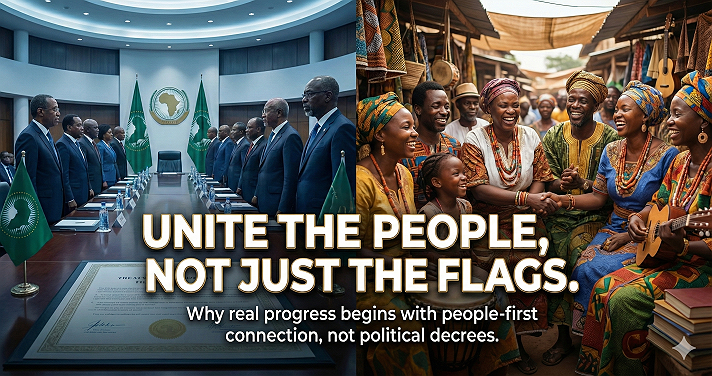



A House Built on Sand: The Futility of Political Unity Without Social Cohesion.
1. The Futility of Political Unity
Political unity is often just ink on paper. Leaders can form economic blocs (like ECOWAS or SADC), but if the average citizen feels no connection to their neighbor across the border—or worse, harbors ethnic or tribal animosity toward them—the political agreements are toothless.
- The Argument: We often confuse state building (institutions) with nation building (people). You can’t legislate brotherhood. When we focus on politicians and governments , we are focusing on the symptom, not the cure.
2. The Legacy of Artificial Borders
This is specific to the African context. Many African borders were drawn by colonial powers (The Berlin Conference) without regard for the people living there, often splitting ethnic groups or forcing rival groups together.
- The Argument: Expecting politicians to solve unity within these artificial borders is a tall order. The "People-First" approach argues that cultural, trade, and social exchange between ordinary citizens is the only way to stitch these artificial wounds together. The people must erase the borders in their minds before politicians can erase them on a map.
3. The "Divide and Rule" Mechanism
Why have politicians failed to "make it happen"? A cynic would argue that disunity actually benefits the political elite. Tribalism and regionalism are often used as tools to secure votes and stay in power.
- The Argument: If the people wait for politicians to unite them, they will wait forever, because division is profitable for the ruling class. Therefore, unity must be a grassroots movement. When the people are united, politicians are forced to follow their lead—or be replaced.
"Culture eats policy for breakfast. You can sign a treaty in a day, but it takes a generation to build trust. Stop trying to unite the flags and start trying to unite the people."
4. Stop Waiting for Permission to Unite:
- The politicians meet in grand halls to discuss unity, yet the borders remain closed and the tariffs remain high. But here is the secret they don’t want you to know: Unity does not require a signature on a treaty.
We can build a united Africa today, without government permission, by weaving our societies together through Trade, Art, and Education.
5. Here is how we take the power back:
a. Economic Unity: Trade Without Borders
Governments obsess over currencies and regulations, but commerce flows like water.
- The Action: Buy African First.
- The Practice: Whenever possible, source products and services from within the continent rather than importing from overseas. If you are an entrepreneur, look for partners in neighboring countries, not just in Europe or Asia.
- The Impact: When we trade with each other, we rely on each other. Economic dependence creates peace faster than any diplomat can. We must build supply chains that ignore the artificial lines on the map.
b. Cultural Unity: The Language of Art
Music, film, and fashion travel faster than passports. Afrobeats and Nollywood have done more for African unity in 10 years than the African Union has done in 20.
- The Action: Amplify the Culture.
- The Practice: Creatives must collaborate across borders. A Nigerian artist featuring a Tanzanian vocalist; a Kenyan fashion designer using Ghanaian textiles.
- The Impact: Art humanizes "the other." When you sing someone’s songs and watch their stories, you can no longer be easily convinced by a politician that they are your enemy.
c. Intellectual Unity: Education as a Bridge
The colonial education systems were designed to separate us—to make us look outward rather than inward. We must re-educate ourselves.
- The Action: Know Thy Neighbor.
- The Practice: Utilize digital platforms to share skills and history. We need student-led exchange programs (virtual or physical) where youth in Lagos connect with youth in Nairobi to solve common problems.
- The Impact: Ignorance is the fuel of division. By learning our shared history—and our shared future potential—we inoculate ourselves against the "divide and rule" tactics of the elite.
Closing Thought
"A government decree can tear down physical walls, but only the people can tear down walls between themselves . If we wait for the politicians to unite us, we will wait forever. But if we unite ourselves through our markets, our music, our activity and our minds, the Politicians and Governments will have no choice but to follow our lead."